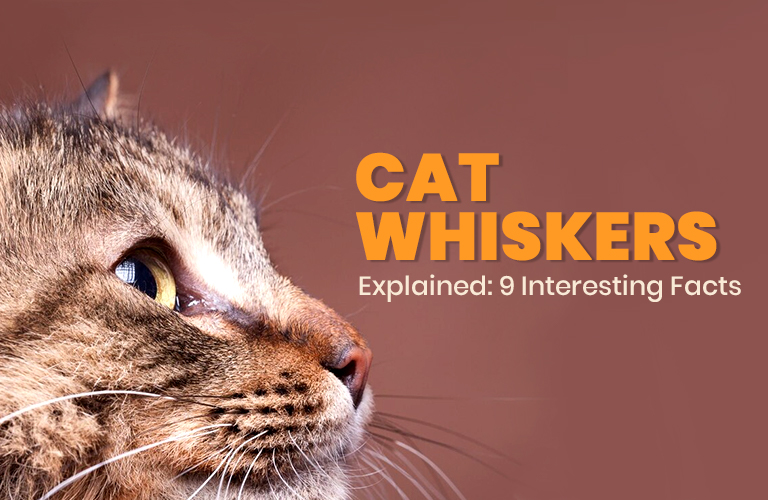
Scientifically known as vibrissae, cat whiskers are not just meant to add to your feline babies’ beauty. In fact, they play a crucial role in your cat’s daily life, being their sensory tools. The whiskers are deeply embedded in the cat’s body, connected to nerve endings and blood-filled sacks, making them extremely sensitive to touch and vibrations. In this blog, we will discuss some interesting facts about cat whiskers that you, as a cat parent or a cat lover, would love to know. Read on to find out more.
Interesting Facts About Cat Whiskers
Let’s take a quick glance at some of the interesting facts about cat whiskers.
1. Whiskers should never be trimmed
Cat whiskers should never be trimmed because they are essential sensory tools connected to their nervous system, surrounded by nerves and blood vessels. They are essential for a cat’s balance and sense of direction. Trimming their whiskers will leave them temporarily blind, deaf and disoriented.
2. Whiskers are very sensitive
Cat whiskers are extremely sensitive as their hair follicles are richly embedded with the animal’s nerve cells and blood vessels, making each of the whiskers a sensory organ. When a whisker touches any object, a detailed signal is sent to the cat’s brain regarding the object. The organ thus helps cats navigate, hunt and judge spaces even in the dark.
3. Cats shed their whiskers
Cats naturally shed their whiskers like they shed their fur. Therefore, it is common for cats to shed one or two whiskers occasionally, which are replaced by new and healthy ones. While shedding whiskers is normal, it happens less frequently than fur shedding, and cats generally maintain a full set of whiskers at all times. However, if your feline loses multiple whiskers at once, it could indicate an underlying health issue and a need to call for medical help.
4. Whiskers help cats see in the dark
Whiskers help cats see in the dark by providing them with a sensory advantage that complements their night vision. While cats cannot see in complete darkness, their whiskers detect subtle changes in air currents and vibrations around them, allowing them to sense nearby objects and obstacles even when visibility is very low. They act like a radar, enabling cats to navigate safely, avoid collisions, and hunt effectively at night or in dim light conditions.
5. Whiskers are generally as wide as a cat’s body
Most cats have whiskers that are as wide as their body, generally ranging from 2 to 7.5 inches. This proportional length helps them judge whether they can fit through narrow openings by touching their whiskers to the sides, enabling accurate spatial awareness.
6. Every cat has a unique whisker pattern
Every cat has a unique whisker pattern, similar to human fingerprints. The number, length, spacing and arrangement of whiskers are unique to each cat, making their pattern distinctive and specific to each feline. This uniqueness is very reliable and helps researchers use whisker spot patterns for identifying cats in wildlife studies and conservation.
7. Cats emote through their whiskers
Cats emote through their whiskers, which excellently serve as a form of non-verbal communication. The position and movement of a cat’s whiskers provide significant clues about its emotional state. While relaxed whiskers indicate a calm cat, forward-facing whiskers show curiosity, interest, or a hunting instinct. When the whiskers are pinned back, it indicates fear, defensiveness or aggression. Twitching or moving whiskers, on the other hand, reflects excitement and playfulness.
8. Whiskers are not limited to cats’ muzzles
Whiskers are not just found in your cat’s muzzle. They also found above the eyes, on the ears, jaw, and forelegs, serving a wide range of functions like sensing movement and protecting their face.
9. Whiskers enable cats to hunt with precision
Whiskers play a vital role in helping your cat hunt with precision. The highly sensitive organs are connected to a dense network of nerves that detect even the tiny movements, vibrations, and even changes in air currents caused by the prey. This allows cats to gather detailed information about the size, shape, distance, and movement of their target, even in low-light conditions.
Bottom Line
Cat whiskers are extraordinary sensory organs that go far beyond just being gorgeous facial features. Understanding the interesting role of whiskers helps you appreciate your fascinating pets and the intricate ways they interact with the world around them. So, go ahead and let the healthy cat whiskers grow freely. After all, they heavily contribute to your feline companion’s uniqueness.